Dev Blog – Episode 3: Infrastruktur
Im dritten Teil der First Look Serie haben wir die neuen und verbesserten Methoden für den Bau und Gebrauch von Infrastruktur in Transport Fever 3 gezeigt.
Die Infrastruktur ist in Transport Fever 3, wie auch in allen anderen Teilen der Transport Fever Serie, das verbindende Element zwischen Industrien und Städten und legt den Grundstein für alle Arten von Transport. Mit dem überarbeiteten Gleis- und Strassenbau, zahlreichen neuen, von der Community vielfach gewünschten Werkzeugen sowie einigen neuen und verbesserten Mechaniken ist es das Ziel, dem Spieler zu ermöglichen, je nach Wunsch noch schneller zu bauen oder noch tiefer ins Detail zu gehen.
Bauen ohne unterbrechungen
Basierend auf dem Feedback der Spieler von Transport Fever 2 haben wir begonnen, den Bauprozess selbst zu überdenken, um ihn einsteigerfreundlicher zu gestalten, ohne dabei an Tiefgang und Möglichkeiten einzubüssen. Aus diesem Grund wurde der neue kontinuierliche Baumodus entwickelt. Er ermöglicht es, Strassen und Gleise auf einfache Weise mit weniger Klicks und weniger Ziehen zu verlängern. Nachdem der gewünschte Strassen- oder Schienentyp ausgewählt wurde, startet der erste Klick den Bau und der zweite Klick platziert die Struktur, inklusive einer Live-Vorschau des Ergebnisses. Einfach und intuitiv.
Für komplexere Bauvorhaben erlauben die überarbeiteten Baueinstellungen eine dynamische Anpassung von Parametern wie Höhe und Neigung und helfen dabei, das Transportnetzwerk schneller und mit weniger Feinarbeit aufzubauen. Das ist jedoch kein Grund zur Sorge für alle, die den bisherigen Ansatz bevorzugen: Der klassische Modus mit Ziehen und doppelter Bestätigung kann in den Einstellungen weiterhin aktiviert werden.
Um den Bau paralleler und angewinkelter Strassen zu erleichtern, stehen nun Einrastlinien für Strassen und Gleise als Orientierung zur Verfügung. Kommt das bekannt vor? Kein Wunder, denn dieses Feature wurde bereits vorab experimentell im Herbst-Update 2024 von Transport Fever 2 eingeführt. Seither ging die Entwicklung daran jedoch weiter, und die Art und Weise, wie Fahrspuren erweitert werden können, wurde deutlich verbessert.
Dadurch lassen sich Strassen nun in nahezu jeder Konfiguration aufteilen und zusammenführen: Aus zwei Spuren können drei werden, aus vier zwei, und alles dazwischen. Diese Flexibilität erlaubt den Bau realistischer Knotenpunkte und – bei Autobahnen – korrekter Ein- und Ausfahrspuren anstelle abrupter Spurzusammenführungen.
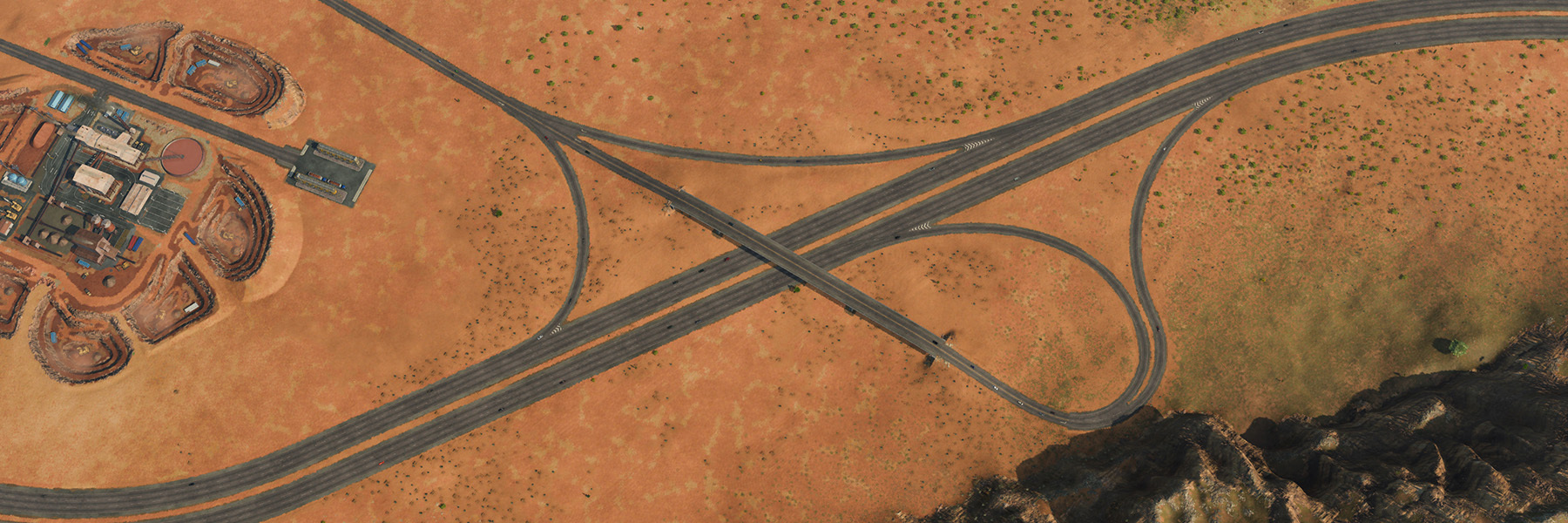
Am meisten profitieren Autobahnen von den neuen Bauwerkzeugen, da Ausfahrten nicht länger auf feste Winkel beschränkt sind und Kreuzungen dadurch deutlich flexibler und schlanker gestaltet werden können. Das ermöglicht elegantere Autobahnführungen, die sich auch in dicht bebaute Umgebungen gut einfügen. Zusätzlich wurde dem Spiel eine neue, kompakte Autobahnbrücke hinzugefügt, die speziell für das Queren und Kreuzen auf engem Raum konzipiert ist. Zusammen erleichtern diese Werkzeuge den Bau komplexer Autobahnkreuze erheblich, ohne dafür übermässig viel Platz zu beanspruchen.
Flexiblere Kreuzungen und Knotenpunkte
Enge Platzverhältnisse sind auch in Städten ein Thema. In Transport Fever 3 wachsen Städte nur selten in perfekten Rasterstrukturen, daher sollten auch Kreuzungen nicht an starre Gitter gebunden sein. Mit der Einführung flexiblerer Kreuzungen können Strassen nun versetzt und in beliebiger Anzahl aufeinandertreffen. Dadurch lassen sich organischere Übergänge, spezielle Formen und besonders kompakte Knotenpunkte realisieren. Diese neuen, flexiblen Kreuzungen sind besonders nützlich beim Übergang von Autobahnen zu Stadtstrassen oder beim Anlegen auseinanderführender Routen innerhalb dicht bebauter Stadtgebiete.
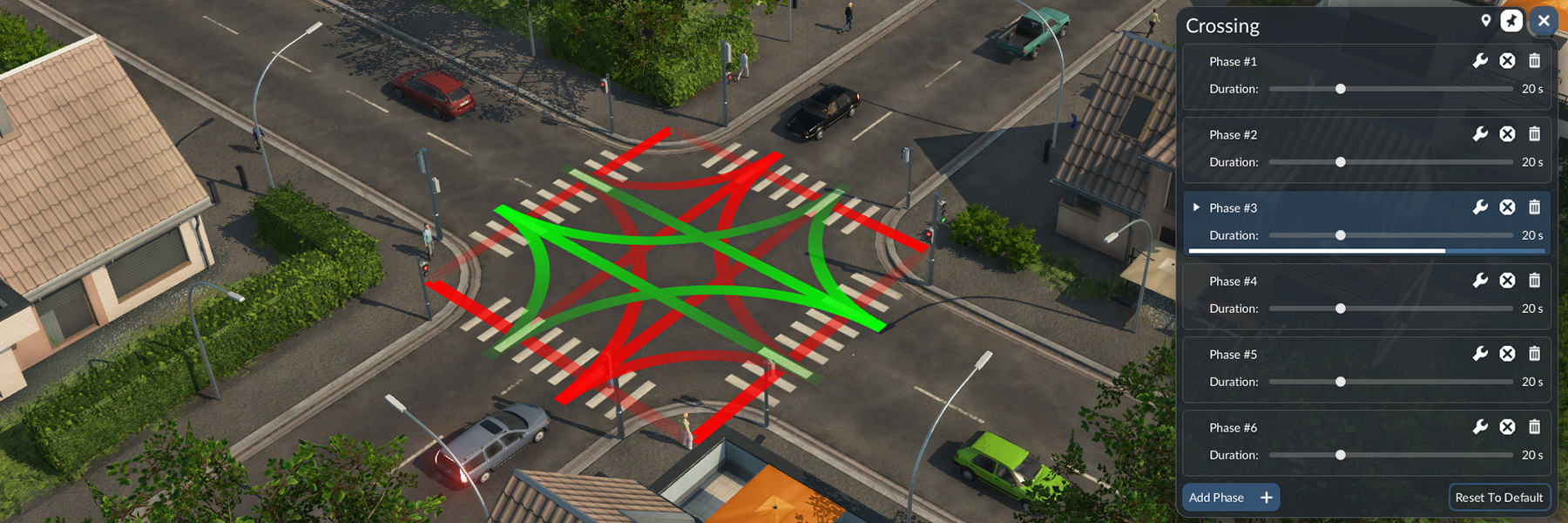
Egal wie komplex eine Kreuzung auch sein mag, mit dem neuen Fahrspurtool können sie versierte Verkehrsplaner selbst bis ins kleinste Detail nach ihren Vorstellungen anpassen. Dabei lässt sich nicht nur festlegen, welche Spuren wo zusammengeführt werden, sondern bestimmte Fahrwege können auch vollständig für Strassenfahrzeuge gesperrt werden.
Nachdem eine Kreuzung gebaut worden ist, kann sie weiter angepasst werden. Fussgängerstreifen, Abbiegespuren und sogar die Phasen der Ampelschaltungen lassen sich individuell anpassen, sodass jeder Knotenpunkt optimal auf seine jeweilige Verkehrsfunktion zugeschnitten werden kann. Wem das zu viel Mikromanagement ist, muss sich aber nicht fürchten: Die Nutzung all dieser erweiterten Tools ist optional und nicht zwingend notwendig.
Auch die zugrunde liegende Datenstruktur bietet grosses Potenzial für Modder. Als mögliche Anwendungsfälle wären zum Beispiel Mobilitätsknotenpunkte mit mehreren Verkehrsträgern, Industrien mit integrierten Bahnterminals oder kombinierte Depots, Wartungsgebäude und Bahnhöfe denkbar. Eine weitere Erweiterung der Schnittstelle ermöglicht es zudem, Fahrspuren für Fahrzeuge und Passagiere per Skript zu definieren, anstatt sie über statische Modelle festlegen zu müssen. Da Bauskripte live aktualisiert werden können, ohne das Spiel neu starten zu müssen, wird die Iteration während der Mod-Entwicklung deutlich effizienter und Modder können wesentlich leistungsfähigere, parametrisierte Konstruktionen erstellen.
Fahrspuren vor Strassensegmenten
Auch die Art und Weise, wie Strassen in der Spielengine hinterlegt sind, wurde grundlegend überarbeitet. Strassen sind nicht mehr durch eine feste Anzahl von Fahrspuren vordefiniert. Stattdessen gibt es nun deutlich mehr Freiheit bei der Gestaltung asymmetrischer Strassenprofile oder spezialisierter Verkehrskorridore, was insbesondere für Modder ganz neue Möglichkeiten eröffnet. Die Zeiten, in denen alle Strassen auf beiden Seiten perfekt symmetrisch sein mussten, sind damit vorbei.
Von dieser neuen Flexibilität profitieren auch der Bau von Fahrspuren für öffentliche Verkehrsmittel erheblich: Bus- und Tramfahrspuren können in der Mitte, nur auf einer Seite oder gar vollständig vom übrigen Verkehr separiert angelegt werden.
Fahrbahnelemente wie Baumalleen oder Lärmschutzwände können entlang von Strassen platziert werden. Sie sind nicht nur optischer Natur, sondern beeinflussen auch städtische Faktoren wie Lärmbelastung und die Verschmutzung durch den vorbeifahrenden Verkehr.
Trams neu gedacht
Trams haben noch weitere besonders spannende Neuerungen erhalten. Mit der Einführung der Gütertrams lassen sich Trams nun ähnlich wie Züge konfigurieren, mit separat angehängten Wagen. Doch nicht nur die Fahrzeuge wurden erweitert – auch die Infrastruktur reicht nun unter die Erdoberfläche und über die Stadtgrenzen hinaus: Wie bei vielen anderen Bautools gibt es beim Verlegen von Tramgleisen einen Untergrundmodus, mit dem sich unterirdische Strecken bearbeiten und erweitern lassen, ohne von oberirdischen Bauwerken behindert zu werden.
Spieler, die ihre Tramnetze über die Stadt hinaus ausdehnen möchten, können Tramgleise zudem neu mit Eisenbahngleisen verbinden und für den Stadt- und Regionalverkehr geeignete Stadtbahnfahrzeuge als sogenannte „Tram-Trains“ einsetzen. Richtig gehört: Einige Fahrzeuge können auf reiner Traminfrastruktur fahren, in den Untergrund wechseln und anschliessend direkt auf Eisenbahngleisen weiterverkehren – alles innerhalb eines einzigen Systems, ohne separate Netze aufbauen zu müssen. Das ermöglicht völlig neue Verkehrskonzepte, die eine innerstädtische Erschliessung mit regionalen Verbindungen kombinieren – sowohl für den Personen- als auch für den Güterverkehr.
“Tram-Trains” passen ihr Verhalten dynamisch an die jeweils befahrene Infrastruktur an. Auf der Strasse folgen sie den normalen Regeln für Strassenverkehrsteilnehmer, auf der Schiene hingegen unterliegen sie der üblichen Signal- und Reservierungslogik des Eisenbahnverkehrs.
Intelligente Priorisierungen, flüssiger verkehr
Apropos Eisenbahn: Ein Grossteil der oben beschriebenen Änderungen an den Bautools gilt so auch für den Eisenbahn-Gleisbau. Für eine effizientere Nutzung der Gleisinfrastruktur wird zudem die Priorisierung von Linien eingeführt. Standardmässig haben alle Verbindungen die gleiche, normale Priorität. Es liegt nun an den Spielern selbst, den einzelnen Linien eine passende Prioritätsstufe zuzuweisen.
So kann festgelegt werden, dass eine Linie Vorrang vor einer anderen erhält, wenn beide denselben Gleisabschnitt benutzen möchten. Züge mit niedrigerer Priorität warten dann an roten Signalen ab, bis sie weiterfahren dürfen. Züge mit höherer Priorität verfügen zudem über eine grössere Reservierungsdistanz auf der Strecke, wodurch Signale ihnen bereits aus grösserer Entfernung den Vorzug geben. Das reduziert unnötige Bremsmanöver deiner Schnellzüge, insbesondere in stark ausgelasteten Netzen.
Wenn ein Netzwerk so stark ausgelastet ist, dass Linien umgeleitet werden müssen, ist das Einrichten von Wegpunkten jetzt einfacher denn je. Es müssen keine speziellen Wegpunktschilder mehr im Voraus gebaut werden – stattdessen kann im Linienmanager ganz einfach ein Punkt ausgewählt werden, den die Linie passieren soll. Das ist sowohl an Land, wie auch auf dem Wasser und sogar in der Luft möglich.
Die Feinabstimmung der Routen hilft ausserdem sicherzustellen, dass Fahrzeuge regelmässig an Wartungseinrichtungen vorbeifahren. Solange die Kapazität des Wartungsgebäudes nicht vollständig ausgeschöpft ist, werden Fahrzeuge automatisch repariert, solange sie sich innerhalb eines bestimmten Radius um das Gebäude befinden.
Blick nach vorne
Die Verbesserungen an der Infrastruktur in Transport Fever 3 sollen Spielern Werkzeuge an die Hand geben, die sich ihren Ideen anpassen – und nicht umgekehrt. Ganz gleich, ob man einen schnellen und intuitiven Bau bevorzugt, oder sich in die tiefgehende Optimierung von Verkehrsströmen vertiefen möchte: Die Systeme sind darauf ausgelegt, jeden Spielstil optimal zu unterstützen.
Wir sind gespannt auf die Transportnetzwerke, die ihr bauen werdet – denn die Infrastruktur bildet nur die Grundlage für alles, was noch kommt.
Matthias Gürtler
Lead Product Engineer



111 Antworten
This is so awesome! A big thank you for the incredible work!
Just a thought: would it be possible to have an option to let roads and tracks be disused instead of just removed (i.e. no more maintenance costs, dilapidated appearance over time, can be built over, etc.)?
I would love to have something like this.
I will often use modded tracks, like the Old Tracks mod from FL0R1AN to do soemthing aesthetically similar for long disused lines – rather than destroying them completely.
Yes. I use that old tracks mod as well, but for roads there are no equivalents and I have to resort to painting and height-adjusting the terrain, which is very troublesome and never as good.
I’d love that, hope the devs see it. I love the idea of abandoned infrastructure… it’ll make for a far more realistic experience. Plus, if it ever gets to the point of where you want to re open a line… it’ll be good for that
It would be so cool if the game was released for Mac right from the start.
Das klingt alles schon mega interessant. Gerade das Städtebauen und die Stadtbahn! ❤️🔥
Was ich mir noch wünsche für den Schienenverkehr & Straßenverkehr, dass die Fahrzeuge nicht fest der Linienspur folgen. Also z. B bei der Schiene ist ein Abschnitt mit Mind 2 Gleisen pro Richtung verbaut, nebeneinander. Da wünsche ich mir, dass der Zug schaut ob Gleis A belegt ist und Gleis B nutzt, OHNE wegpunkt oder halt.
Da stoße ich aktuell in TPF2 an die Grenzen was mich zu “nothalten” zwingt, für eine freie Strecken Auswahl.
Looks great. When is the game released?
We’re on track to release the full game later this year. As soon as we can confirm the launch date we’ll announce it everywhere!
i wonder wich quater it will come out. i check this website every day…
Offenbar wieder keine Möglichkeit einen Bau – eine Aktion rückgängig zu machen – schade denn das sollte eigentlich Standard sein…
Do you mean a Undo Buttom cause that would be ace
Will cars park in Car Parks
Wow. Einfach WOW. Ich Freue mich wirklich sehr auf das spiel.
was mich noch interessieren würde wäre, ob man epochen ausschalten kann oder irgendwie anders auf die optik der städte einfluss hat. ich würde in spielständen, die fortgeschrittener sind, begrüßen, wenn die geschichte der karte erhalten bliebe und nicht alles auf moderne architektur aktualisiert wird sondern nur ein paar neubauten. so dass historische teile entstehen. gerade bei TF bietet sich das ja an, weil man ja ohnehin durch die epochen reist. ich glaube das ist für viele nur eine nebensache. ich fänd es hingegen echt toll. evtl könnte man das ja auch optinional machen. das man gebäude unter “denkmalschutz” stellen kann. oder ganze städte und nur neue gebäude in der entsprechend aktuellen form entstünden.
schön war beim vorgänger ja schon, dass man einfluss auf den fortschritt der epochen an sich hatte, unabhängig von der spielgeschwindigkeit. ich baue darauf, dass wird das auch im dritten teil bekommen.
aber auch wenn nicht. ich bin sehr gespannt was noch an neuigkeiten dabei sein wird.
As with the previous game you are very much able to control the time settings in the game. If you want to remain forever in one era you will definitely be able to do so.
Was Christoph meinte, dem Spieler eine Möglichkeit zu bieten, bestimmte Gebäude unter Denkmalschutz zu stellen, so dass sie nicht im Laufe der Zeit durch andere oder modernere Gebäude ersetzt werden. Dies würde zu einem glaubwürdiger Stadbild führen. Ich unterstütze diese Idee!
Ich glaube das gab es auch so in Sim City 4(oder in einem anderen Städtebauspiel).
That looks very promising. I still hope that the signals can be more intelligent and versatile. Just red and green is fine as a basis. But I would like to see different signal patterns that can be set depending on the route.
Can’t wait for TPF3! Is there going to be track speed restriction on launch for trains?
What will be the ideal setup to run TPF3 at maximum settings
The game is still in development, and finalising the recommended technical specs for players won’t happen until we’re close to release. If you can play other recently released, modern builders and simulation games you should be able to run Transport Fever 3. Apologies that this is a little vague, but it should give you some idea of what to expect.
Wow, das kling alles einfach nur toll !
Ich bin gespannt dann zu sehen, wie die Linienpriorisierung funktionieren wird.
Aktuell muss ich immer Extragleise bauen, damit meine Personenzüge Platz haben. Ob ein Güterzug 5 Minuten später kommt oder nicht ist mir egal.
Ich habe aber eine Frage:
Könnt ihr Fahrpläne (ähnlich der Fahrplanmod aus dem Steam Workshop) hinzufügen ? Das zusammen mit der Priorisierung wäre unschlagbar.
Wenn das jetzt rauskommen würde wüsste ich nichtmal, was ich zuerst machen soll, so viel tolles Neues gibt es 🙂
Ich wünsch mir ja immer noch eine Fahrplan Funktion 🙂
Since Train Fever this game excel on graphics. Sure today Train Fever graphics would be considered ugly, but I remember very vividly at the time, for me was number 1 aspect of the game. And I don’t know how, the graphics looks even better than Transport Fever 2. The green fences looks so realistic and random. The vegetation looks even better. Very well done. Can’t wait to play this game.
Thank you, that’s very good to hear! We’re very pleased with how the game looks already, and hope you will be as well when we release later this year.
Das hört und liest sich bisher alles sehr gut an, das wird ein TOP Nachfolger!
Ich hoffe aber, das wir dann mehr Einfluss auf den Städtebau haben werden, denn die KI hat leider immer sehr merkwürdig Städte hochgezogen.
Top wäre es, wenn man Wohn, Gewerbe und Industriegebiete/Zonen als Spieler festlegen könnte.
Denkt hier bitte an die Schönbauer, die alle TF Teile so lange am Leben gehalten haben.
Das hört sich alles sehr geil an.
Aber…
Die Werkstätten haben mich noch nicht überzeugt.
Wenn ich das richtig verstanden habe, müssen alle Linien einen Umweg haben um an einer Werkstatt vorbei zu fahren.
Oder man muss die Map mit Werkstätten vollpflastern damit alle Linien Eine in der Nähe haben.
Warum kann ich nicht z.B. sagen, dass wenn der Zustand eines Fahrzeuges unter 30% fällt, das entsprechende Fahrzeug automatisch die nächste Werkstatt aufsucht und dort hineinfährt um über Zeit repariert zu werden?
Dadurch wäre es trotzdem von Vorteil Werkstätten an logischen Stellen zu platzieren (Da wo viele Linien sind oder Linien mit Fahrzeugen mit hohen Betriebskosten) ohne genau darauf zu achten, dass auch ja jede Linie gerade noch so im Radius einer Werkstatt ist. Wenn die Werkstatt weiter weg ist, und reparaturbedürftige Fahrzeuge länger fahren, habe ich halt für eine längere Zeit einen Verdienstausfall. Bei günstigen Fahrzeugen wäre das aber verkraftbar. Da die Grenzen zu ziehen, läge in der strategischen Beurteilung des Spielers.
Ein anderer Punkt wäre der höhere Realismus, da Fahrzeuge nicht mehr auf magischer Art und Weise beim Fahren über die Luft repariert werden, nur weil sie sich in einem bestimmten Radius befinden.
Vlt. kann man die Reperaturgeschwindigkeit von Werkstätten auch (wie Industriegebäude) boosten, indem man dort Arbeiter hinfährt.
That’s look so amazing!! I just add a small question. Will there be a better option to block construction by artificial intelligence to make parks or to specify to the AI where I want skyscrapers, houses or industries? Keep up the good work, I’m really looking forward to the release!!!
Yes! You will be able to use the same blocking tools with roads that were introduced in Transport Fever 2 by making certain roads or streets company owned, thereby preventing towns from building in that area.
Da pflichte ich dir voll und ganz zu!
Vielleicht klappt es bis zum Release um dieses Feauture ein zu bauen!
Thank you for Transport Fever 2, can you add something similar to Freestyle Train Station mod to TP3 please?
If signal reservation distance can be extended (assuming a path can reserve through multiple signals) would that mean multi-aspect signals are now viable? The signal model we’ve seen does have 4 lamps, so it certainly could show a few aspects, right? Frankly, it’s always bothered me that the TF series has such realistic train infrastructure compared to all the other transport tycoons out there but then the signals are just green or red, same as most other games in the genre (except like Chris Sawyer’s Locomotion and the JGR Patch Pack for OpenTTD). TF3 could really one-up the rest of the genre (again) if signals were more sophisticated.
Consider how our train drivers in TF2 and prior are absolute maniacs, either always using as much power as they can or braking super hard at the last possible moment, which isn’t a very realistic or fuel-efficient way to operate a train. If our virtual operators could see a caution signal warning that the next signal hasn’t been reserved and is still red, or that the next signal is followed by a diverging junction with a lower speed limit, they could preemptively coast or gently brake down to a safer speed instead of screaming along at full throttle. That’s more believable and burns less fuel, which (I hope) should lead to the simulation calculating lower running costs too. But that’s just my dream, service priority is already very useful to convince our silly train drivers to brake only when needed.
Könnt Ihr das Erscheinungsdatum nicht zu spät ansetzen? Ich habe 3 Monate Kündigungsfrist. Da das Spiel so gut werden wir, ist es leider nicht mehr mit meiner Arbeit vereinbar… 😬
Will it also be possible to let the trains run on the tram network because it is now also possible the other way around?
None of the trains that are included in the game are able to run on light/tram rail, however a modded train that is specifically designated as light rail will be able to do so. This should facilitate street-running trains with ease after the game has released.
Liebes UrbanGames-Team,
ich muss gestehen, dass sind durch die Bank weg tolle, neue Features! Die Qualität und Expertise, die hinter diesen Features steht, sind unheimlich hoch. Wenn das alles so funktioniert, wie versprochen, dann erwartet uns hier wohl die beste Transport Simulation des Jahrzehnts.
Zwei Wünsche oder Ideen hätte ich zur Infrastruktur:
1) Ich fände einen Planungsmodus super hilfreich. Ich würde gerne vollständige, komplexe Trassen vorplanen, aus allen Winkeln betrachten, einzelne Radien, Verläufe oder Brücken ändern und sie dann erst bauen. Am besten inklusive Terrainanpassungen und Variantenvergleich. Wie oft fällt einem hinterher auf, dass einzelne Abschnitte seltsam wellig geworden sind oder die “optimale” Trasse nun einen Berg schneidet, wo man vielleicht hier und da noch etwas angepasst hätte. Ich weiß, für die Schönbauer ist das alles kein Problem, die haben unendlich viel “Geld”, aber für die Wirtschaftssimulation, insbesondere die höheren Schwierigkeitsgrade oder am Anfang des Spiels, macht es doch einen erheblichen Unterschied – vielleicht als Alternative Idee zum Undo-Button.
2) Bei der Signalisierung ist es Stand der Technik, diese dynamisch zu halten. Sprich für den Straßenverkehr, dass abhängig vom tatsächlichen Aufkommen einzelne Richtungen mehr oder öfter Grün bekommen. Eine Möglichkeit Straßenbahnen, Busse oder den eigenen Wirtschaftsverkehr absolut über dem allgemeinen Individualverkehr priorisieren zu können, wäre natürlich fantastisch (und ist auch Stand der Technik 😉 ) – also das meine Tram immer sofort Grün hat, egal wann sie ankommt. Für die Epoche der Zukunft/Moderne, könnte ich mir vorstellen, dass gar keine Signale mehr notwendig sind, sprich C-ITS/C2X für die Straßeninfrastruktur und ECTS Level 2+ für die Eisenbahn – dynamischen Blöcke, um nochmal den erwarteten Kapazitätsgewinn für die Zukunft abbilden zu können.
Vielleicht sind das auch Ideen für die Modder?
Was haltet ihr von meinen Vorschlägen? Vor allem ersterer wird für meine Planungen dringend benötigt 🙂
So oder so, ich bin sehr gespannt auf das neue Spiel und kann es kaum erwarten die neuen Features auszuprobieren.
Beste Grüße an das Team!
I watched the video. It’s a road construction tool that reminds me of a famous mod for “Cities:2”.
In TPF2, I had trouble with the ground level around stations not matching the surrounding roads and buildings. I’d like an option in the construction tool that would tilt and adjust the height of stations to match the surrounding terrain.
P.S. I found out about the December release through your email. I found out about the New Year’s release through a news update on Steam.
Nothing to do with infrastructure in the game, but is there any chance you are updating your in-game font so it looks better and more professional? I’ve been with you all since Train Fever and this is probably my number 1 non gameplay related pet peeve. The current font is often difficult to read and also reduces, for me, the beauty of the otherwise great graphics in the game. Sorry if this is a weird request 😁
Weird requests are definitely welcome – and yours isn’t all that strange. We are working on ensuring that the interface is as clear as possible. These kinds of requests help validate the importance of accessibility – even if it’s something as straightforward as font selection.
Not sure if this has been asked/answered before. But would be interested to see how large cities will be in TpF3.
In TpF2, they always felt slightly too small for the more “realistic” networks
Would be great to see an increase in size – especially with the use of underground services
I know this sounds nitpicky and arrogant, but I’m not too sure about the current implementation of the maintenance mechanic. The consequences for maintenance are great, but the making sure something is maintained is not. Currently, this mechanic penalises me for not working with it, but it does not significantly alter the gameplay, other than making me place a few buildings quickly, as I need to pass through the massive radius of a maintenance building. It feels cheap as it is right now.
There are all sorts of ways that this mechanic could be improved. Let me show. What if you actually had to add the building as a station in the line? I can’t say whether it will improve the gameplay, but it does affect it a lot more. I have to make a lot more considerations now. I think with the old mechanic, I would build roads, lines, and then place the maintenance building at the most convenient place as an afterthought.
Now, when building roads, I will also consider maintenance. When setting up lines, I will actually consider maintenance, and I will be optimising the number of trips to the building. Again, this is just an example showing the effect of a much more comprehensive maintenance mechanic.
This is a good question, and one we’ve considered in the development of the game. The choice always comes down to whether a new feature or function makes the game better to play. Is maintenance important? Yes, in Transport Fever 3 we’ve made the condition of your vehicles impact their performance, making maintenance essential. Since our abstract game world runs without peaks and troughs in demand (as dictated by the time of day) we don’t want players to have to take their services fully into a workshop/depot/maintenance building in order to be kept fully operational. This would create more problems and hassle for players than it adds fun, so we’ve used a slightly simplified approach.
Does that make it forgettable? No. As your fleet volume increases you’ll need to think further ahead, and provide better coverage making the placement of maintenance facilities a strategic decision that affects overall performance. As with every feature this is a careful balancing act, and we’ve considered multiple different approaches to find the one we feel adds gameplay entertainment.
Many players still hope to have a separate maintenance building, where trains can only be fully restored if they enter and stay for a certain period of time. This does not conflict with the current functionality and can be offered as an option for players.
I would second this, especially for trains a big part of the aesthetic that I feel is missing is resupply and maintance on tracks that for model building always has been a big staple. Making that functional would be a big win.
Imagine a steam locomotive stocking up for Coal and Water. Or an electric train going to an open air mantainance depot at the end of the line.
This would be part of the planning allowing for more complexity in the network while also modeling some authenticity.
Offcourse this will probably not happen with in this game but I really would love train yards in which cargo trains can be disassembled and reassembled to distribute across a network.
Hope you will be able to release a Linux version of your game, like the previous one. A Linux release would be another strong signal from you for the community, and another dab at a Tampere-based city game.
You showed underground station, including underground tramway (great great stuff!). Can we expect elevated tram station (à la US LRT, Seattle-style)? Or do you intend for the tram to go in train elevated station, since they are compatible with train-track?
Graphics of the game looks great from the videos and picture. Cheers
One feature I am missing in all transport simuilation games I ever played is being able to design new infrastructure, tweak it (see total cost while doing so), and then finally built it when I am happy with the design / secured enough funds
Some of them have it (TF 2 might have had it, too long ago I played) but what is always missing is the possibility to have multiple drafts / projects going on
For example:
I am looking at a big expansion of train network. For this I have to build multiple stations / multiple rail lines etc…
I am in edit mode, tweak it, trying to save money etc…
In the meantime I notice an inefficieny in part of the existing network.
I now have 2 options
– Discard my full draft and having to start over
– Live with the inefficiency (in some cases it might be so bad this is almost impossible to do)
I often go for the 3rd option. Quit the game and stop playing
Bonus points for this feature to be able to split up an existing project so it can be built into phases.
That sounds all amazing and I can’t wait for it. I especially also love the priority with further distance reservation. I still have some hope for a distant signal, you know, that could reserve even further away as soon as the the distant signal is passed or similar. But I guess it might not happen. Was really hoping for it, as the signals in the screenshots had four lights. Oh well. But I mean everything else is fantastic. To be able to get trams onto train tracks. So far I think I love the maintenance idea and how it is done. That intersection with the BLT trams looks gorgeous. To have so many freedoms to have advanced configurations (but optional) is awesome. Love it!
I would love to see a planning mode when building infrastructure to be able to see the whole project and it’s cost before confirming. That’s especially useful in longer intercity connections.
I’m a bit concerned that a lot of what we seeing is about roads and cars instead of trains. Trains are the reason i play this game!
Trains are absolutely crucial to the game, if not the core part of it. That’s why we’ve improved signalling priorities (as detailed above) to help give greater control over your train network. Rest assured that rail will still likely make up the core of your game.
One more follow-up question on the signalling priorities:
Is it possible to add track-based priorities on top of line-based ones? For example, should the main tracks have higher priorities than side tracks?
This is because you may not want the prioritized line to get green light all the time, for example, when a passenger train is departing from the side track, and a cargo train is coming from behind on the main track, you may want to let the cargo pass first rather than force it to stop on the main track.
I would appreciate seeing a ‘planning mode’ introduced. Say you have a major rework of a termination station, adding platforms, reconfiguring rails approaching the station, demolishing buildings and rerouting a few roads. In ‘planning mode’ you could “build” all the new infrastructure, mark items for bulldozing, etc, see the cost, and save the ‘project’ for implementation once the moment and the money is right. Simple interface with list of planned projects. You hit ‘go’, and construction (and expense) commences. Even give it a time delay depending on cost or complexity.
Would also be useful for planning long lines around mountains, etc. without needing to invest until you are happy with the result.
I fancy all these ‘planned’ items could show as a ghosted transparent blue graphically.
Hope there will be a bike/car parking system and a custom campaign modifier.
Great looking game. Already on my wishlist and can’t wait to play it. Some of the updates listed here are impressive gameplay and experience improvements over TF2
Couple of things that bothered me always was the thickness of the wires for electrified rail, and the lack of availability of 3rd rail as an electrified rail-type (without modding support). I wish these could be improved
Does the part of “asymmetric road layout” include asymmetric roads as part of the base game, like 3 lane road with 2 lanes going one direction, 1 lane the other direction? Or was this an “artistic liberty” when they were shown in the announcement/non-gameplay trailer?
And I guess, as you removed a click from road and rail construction, we are further away from Transport Fever 3 allowing us to modify the start point of a road, when we start a new road/rail?
Will have Double Decker buses from the start & better bus station laouts
Please add Asymmetric one-way road, for example, with emergency lane by the right side. In TF2, you cannot do that, both left and right have emergency area.
Hello, please can you say in the next First look, wenn is coming Transport Fever 3?
We’re still very much on target to release in 2026. When we’re ready to make the final release date public we’ll make a big announcement, but until we’re 100% confident the game is ready, we’ll keep our target date to ourselves. We know that players are keen to get stuck in, but we won’t announce a release date until we have maximum confidence.
Thanks, Sam. We’re absolutely excited and can’t wait to enjoy your game. I’m sure that 99.99% of us would rather wait for a high-quality game than get a broken one like CS2. So thanks to the team for being professional instead of chasing quick profits
Absolutely fascinated by all the new developments till now. Had a small query though, would there be an option for Left-Hand or Right-Hand traffic in base game?
Specific question on train signals – priority is great, but to build on that will there be ways to make single-track working more efficient/possible?
At the moment you can’t have multiple single track stations in a row because trains will inevitably get stuck opposing each other. Being able to manually set signal blocks to incorporate multiple single track stations would be great (via an option remove the “integrated” signal from stations possibly), and you could also extend the priority feature to allow batches of multiple trains travelling in the same direction to occupy the line to get max throughput. I believe this is how single track lines are worked in reality in sections without passing loops.
That’s a tricky question to answer – where do the trains go at the end of their route? Running a procession of trains up a single track is possible, but at some point if you have opposing services you have to have some kind of passing opportunity, whether that’s at stations or using a passing section of track. Let’s say you have 4 trains running on a 3-station track (1 at each end, 1 in the middle). They start out running A-B-C with the second train waiting for a clear signal before proceeding. The trains hit different terminals upon reaching station C and reverse the course. This would work fine, providing train 1 were to wait until the arrival of train 3 before setting out. A wait until full instruction might provide the necessary delay here. It’s an interesting puzzle, and getting signalling/waiting times right is key, but I’m not certain of why you’d want to do this… other than, purely because you want to.
(Apologies, this was an interesting thought experiment, and I don’t have a categorical “yes” or “no” answer.)
Hi Sam, thanks for answering – there’s two levels to this 1) treating a single track section as one signal block, regardless of number of stations, and 2) less key, but useful, is allowing batches of trains to follow each other on single tracks.
The use case I’m thinking of is where you have a single track branch line with multiple (single track) stations – either to keep costs low of due to space constraints. The ends of the single track section could be a double track line, or a multi-track termini – which as you say would accommodate reversing/passing – or a single track station if costs are critical.
In the real world, train (A) would get authority from signalling to occupy the *entire* single track section, regardless of the number of stations along it. All other trains would have to wait outside the single-track section until train (A) had cleared the section. This doesn’t rely on timings, just on the signal logic understanding track blocks and occupancy.
In TF2 if you have a line that stops at all those stations, then trains will get stuck opposing each other as they only consider if the path is blocked up to the next station, rather than if the whole single-track section is clear. You can fudge it with timetables, waiting times etc. but it’s fiddly, and the signals won’t help you if timings go awry.
On point 2) more complex logic would allow multiple occupancy of the section for trains moving in the same direction to increase throughput, with opposing trains waiting until the whole section is clear. Let’s say Train A enters a single track section Sxyz with three signal blocks Sx Sy Sz – first it enters Sx, then Sy, the Sz . Sxyz is considered fully occupied to trains approaching from the opposite direction and they wait, but if train B is following behind train A, then when A enters Sy, B enters Sx. When A –> Sz, B–> Sy, and so on.
This allows higher throughput than the initial whole-section occupancy method as same-direction trains can run directly behind each other rather than waiting for the whole section to become clear. Particularly useful if you have a slow freight train trundling through Sxyz, and a faster passenger train behind it. The passenger train can stop at Sx, Sy, Sz to load/unload as soon as the freight train clears that block, rather than waiting until the whole section is clear.
Hope that makes sense! As I say, I think controlling occupancy over whole single-track sections is a key part of proper signalling, and the batch/sub-section system is a nice-to have if we’re feeling fancy!
Really great to see how roads will be defined by component lanes, but could something similar be done with railway tracks? I.e defined in terms of ballast, sleepers, rail profile, electrification, gauge etc? The game would calculate max gradient/axle load/speed so players could fine tune their designs for specific applications. The three default track types would just be pre-defined combinations of parts and parameters using this system
That would give players and modders a lot more flexibility whilst also keeping menus neater in theory as variants could be selected/created on the fly.
This interface could be even better extended to formally allow things like rack railways and 3rd rail electrification via mods, as long as the checks could be put in place for the right trains to use them.
Super elevation could be another parameter to include, but where there’s a trade-off between loading gauge and speed in corners.
Is there any chance to have an option to have the start date be 1750, the start of the Industrial Revolution? I currently use the mod to start TF2 at 1800. I know that it is quite boring at the beginning but it allows me to start developing early supply chains and experience how transportation develops from ships to trains to road and air. It would be nice to have a built-in early start date option, you can add a disclaimer that the Industries may not match the era and that gameplay is extremely slow. The last transport game I played was Simutrans…which did a great job with this.
The new game starts in the year 1900 before then running well into the 21st century. Why 1900? Because this is the point where the vast majority of players started their games in Transport Fever 2, and shifting our focus to this point onwards has allowed us to spend a lot more time on the vehicles and urban environment in the 20th century. There is nothing to stop an earlier start year being added by the modding community, particularly as the number and variety of older steam power increases.
Are you also planning to change the road vehicle AI? From what we could see in the trailer (and I understand that any new AI improvements just have not made it into the showcases yet!), it feels like the same road AI as in TF2, where it just cut in front of traffic if it physically fits into a space, regardless of vehicles already travelling on the same lane. Or vehicles cutting over three lanes to catch an exit, even if there are other cars in other lanes that then have to brake quite a bit.
Also, I would really appreciate it if there were right of way / yield rules that one could implement to stop vehicles from entering a busy road. TF2 logic seems to be first come, first serve, which generated quite a few traffic jams.
I think you are already headed in the right directions with how the new street crossing editor looks, so fingers crossed that you will also adjust the vehicle behavior a bit 🙂
Will there be a function to automatically build double lane tracks instead of on and then placing another right next to it?
Also will there a function to auto afd signals on the road?
These two features where the first I added with mods when they came out and in my opinion it would improve accessibility if it would be an optional tool while building tracks.
Would it be possible to recreate, for example, the High Five interchange in Dallas, TX?
While I’ve not seen an engineering schematic of the interchange, from aerial pictures there doesn’t seem to be anything the game couldn’t reproduce… it might be a real challenge to pull off though.
I like the idea of vehicles having to return to their depot for repairs, it’ll give players more incentive to keep the vehicles well repaired as to reduce downtime…. And different levels of reliability for different vehicles so you can see what suits your system more. Like… how using a high speed train on a low speed line could damage the gearing… creating more downtime and forcing you to realise… hey that doesn’t belong here. The same as perhaps pushing lower speed trains to do higher speeds? You can make a train go faster but it comes at the cost of maintenance.
Flooding would also be a cool idea… nothing destructive, but forcing passengers to take alternate routes in response to events would be very dynamic
I also think there should be some sort of system for turning trains around that are hauled by a locomotive. This is something I would LOVE to see… either a turn around loop, or the locomotive detaching from the train, then moving to the back.
can’t wait to play, looks amazing and the new mechanics are brilliant, everything we wanted in TF2. I know you don’t gonna confirm that but i hope it’s gonna be released in Q1 or Q2 of 2026
Regarding the priority of routes, this feature is very useful and can enable train overtaking. However, for complex routes and large stations, it can still lead to train delays. Moreover, for single-track operations, this does not solve the existing problems. We still need automatically generated timetables that support free editing to address these issues. This is an indispensable tool for the railway system, just as important as the traffic light control system on roads.
Regarding traffic lights, the game currently only has red and green lights, but in the real world, there are yellow lights and combinations like green-yellow lights. Hopefully, the third installment can make better display optimizations for traffic signals.
To add on to many others already asking, I again play TF2 only for the trains aspect. It is really well done except for the signalling and time tables.Priority is a good improvement but I really hope we see something more like yellow aspects and timetables too. One more niche request is to add distinct sounds when trains pass switch points. Right now, even mods can’t support it since the game only supports certain fixed sound injection points,
Are we going to get curvy and sloped stations (like freestyle stations) or are they going to be flat and rectangular?
As someone who has spent hundreds of hours in Transport Fever 2, I can’t wait for the release of TF3 later in 2026. My only wish is to see Turkish language support in the game. It would make the gameplay experience much more immersive for thousands of Turkish fans like me who have been supporting this franchise for years. Please make it happen!
One thing that bothers me in TPF2 is that there is no real incentive *not* to electrify or double a line. At a certain point, you have enough money to just build double electrified tracks everywhere. I am hoping that you will find a way to balance the game in such a way, that this kind of choices will be important for the survival of your company, in so far that there would even be incentive to revert to single track when demand is low, which also happens irl.
Thank you for building this amazing game, and for listening to your audience instead of selling your studio to some huge company who don’t care.
This sounds amazing, out of curiosity, will elevated train or tram stations be added into the game as well or just underground?
This looks great, making road construction more lane-based also makes it more similar to rail construction as well, which should make it a more intuitive experience when building-out large rail and road networks simultaneously. The Traffic light changes and high priority trains is an amazing addition, though given the emphasis on trains in the game it would also be amazing if there were similar, though optional, capabilities available to the rail signalling system as well. At it’s most basic a rail signal with 3 aspects; Go (Green), Go-Slow (Yellow), Stop (Red) would be a (potentially) simple measure to help with train spacing on lines, where if the signal detects another train too close in-front or went by too recently it makes the next train go slower to space them out. Speed signs in general or Rail signals that make trains go slower from certain routes too would be a great addition too, since in TPF2 the only way to do this is to use (modded) lower track speeds which affect every train going by.
On a complete tangent, commendations on the Iron Ore mine visible in the top left of the 2nd image, as someone who works in such industries I can see what all the buildings are meant to represent, albeit in game-scale naturally, and the overall look reminds me of several 1950s-1970s era Wet Plants. The only significant change I’d make would be to make the roads all dirt roads, since even if there were paved roads there it would only take a day of operations for them to be covered in dust and dirt anyway :’D. I also hope with the changes to the industry and cargo systems mentioned in previous blogs we can get train load-out chutes for bulk cargo too, even if in later releases, since a train getting loaded by driving slowly under a chute without stopping is just really, really cool to watch.
The streets still look weird with no parking
Looking forward to TPF3, could become the best game of 2026 for me. There is one major concern, though: I loved TPF2 … until I was mid-game on a very large map. Then performance became horrible. I’m not talking about bird-view FPS but the first person cockpit camera view. Being able to sit into a train or bus and travel across the map is the ultimate satisfaction for me in this game. If I cannot do that with kind of stable FPS (and even if it’s only 30FPS), I am not going to play the game. And TPF2 was horribly limited by the main thread’s performance, making the game unenjoyable for me quite quickly, so I stopped playing the game much sooner than I intended. And I owned a highest-end PC for that time, so the system was certainly not the problem.
Can you please explain in detail if you removed the single-core bottleneck in TPF3, and if yes, how exactly you distribute the load across all CPU cores and the GPU? If TPF3 has the same performance bottleneck like TPF2 then I am not going to buy it. If you fully solved that limitation, I know I will buy and play it for more than 1000 hours.
Performance, particularly in the later game, is a key area of focus in the new game. The main cause of performance decline is that city populations can grow without limit, making an eventual overload in the amount of citizens being processed by the game inevitable. The challenge we’re tackling is in both maintaining the sense of scale, without as big a need for citizen processing as the game progresses. This is less an issue of core-balancing – one core will always carry more load, because it governs what’s done elsewhere – and more acting to prevent the overload.
Thank you so much for your quick reply, Sam, it is much appreciated. I hope “acting to prevent the overload” does not mean smaller maps. The largest experimental map in TPF2 was “just” large enough to have fun with the game on the right scale 🙂
By the way, Cities Skylines 2, in so many ways a very bad example of how to implement and introduce a game in general, also having tons of performance issues for many reasons … but there was one thing that CS2 managed to do well: They managed to make use of the power of all your CPU cores. It very evenly loaded my 20 CPU cores, others demonstrated the same even with 32 CPU cores. So it is possible to distribute the simulation load of such games across CPU cores evenly, without having that one main thread limiting performance while 16 other CPU cores were idle (like TPF2). I hope very much that you managed to evolve your engine for TPF3 to a point where this CPU core load balancing works much better, otherwise all other measures you take are likely just band-aids slightly delaying the inevitable. Thanks again for taking the time to reply to us.
I wonder if railway signals have more aspects than just red or green?
Definitely looking forward to when TPF3 comes out. Carrying on from the newly implemented “manually phased traffic lights”, will there be an option to ‘group’ several intersections together? For example, near where I live we have what’s called a ‘through-about’ where the main dual carriageway goes through the middle of a roundabout. In order for traffic to flow correctly, the traffic lights at both junctions are set up to work together, allowing traffic to flow directly through instead of one set going green and all the traffic being “stuck” in the middle of the roundabout waiting for the next set to turn green. Will this be an option at all allowing us to create “green light corridors”?
Hallo UG/TF Team,
wird es nun auch Schilder, Straßenschilder, Autobahnschilder und Leitplanken geben?
有发售的具体时间吗?
The game is in the late stages of development, and we’re on target for the internal release date we’re aiming for. As soon as we’re positive that the game is going to be ready we will announce the release date.
會在2026的Q1或是Q2發行嗎qq 我好期待
The game is still progressing in development and we’re on target to release in 2026. As soon as we have a fixed release date we’ll announce it.
One of the more painful parts about TPF2 was managing assets from mods. Sometimes, you just want to put down some vanilla rails, but you have to scroll through like 40 different modded tracks and 20 purple icons to find them. And the asset menu was a mess, there would be like 10 categories containing one bus or just a part of a train, but then you have this random folder with 30 different vehicles from multiple mods. 1/3 of my time playing this game turns into just digging through menus to find one specific thing. You’d get a neat vehicle mod only to find out there was no asset version for it.
I’d love to see some user-end asset management tools. Being able to turn off specific assets and create your own folders, and move assets around, would be huge for organisation. Vehicles automatically being added as assets would be nice too.
I completely agree with Amaz A.J. Totally agree, please make the management of mods/assets clearer and easier. Thanks!
can you provide information regarding the estimated price for this game?
We’ll announce all the needed information – from release date, to tech spec, and price when we’re a little closer to launch. Thank you for your patience.
Can lakes on small hills or mountains (and such be made) with associated rivers (some which can function with cargo and/or passenger ships/boats) with the need to bore them (dig them to too deep) the depth of ocean and or bay levels. lakes and rivers typically have surface areas (a well as depth levels) above “sea level”. This would allow railways and transportation related items to more accurately relate to “real life” (giving better visual effects. Not necessarily taking about sea level to extremely high-level mountain tops (not enough space on screen map for that many derivatives on one map). Also, any way to transport over several map layouts. Example: San Francisco Bay area to New York city areas, without them both being on the same “undersized” for distance map. This would allow a reason for jet aircraft and such. Also allow you to make stops along the way. Playter would need to either create a separate map for each area or AI created areas along the way would present its/their individual needs and the human player need only send a plane, ship, train, etc. to that area for those requested components and then receive cargo that area exports back. passengers are passengers. if you desire to actually track the train(etc.) the map for where the item is located would need to be loaded up. Sort of like “flight simulator games”. When in 2026 will game bill released?
Obvious question is obvious: but with signal priorities coming into the game will it be more feasible to have, say, signals on a roundabout?
Don’t put signals on a roundabout. You know this.
That sounds like a challenge to me!
Are railway workshops designed so that trains can enter the workshop from both sides, as in reality, thus providing a possibility to access a single workshop in both directions?
Hello Urban Games Team,
Since I haven’t received an answer to my previous questions, here they are again:
Can buildings be moved?
Will there be a city editor again?
Will there now be signs, street signs, highway signs, and guardrails?
Thank you for your reply!
German:
Hallo Urban Games Team,
da ich leider keine Antwort auf meine bisherigen Fragen bekomme habe, hier noch einmal:
Kann man Gebäude verschieben?
Wird es wieder einen Städte-Editor geben?
Wird es nun auch Schilder, Straßenschilder, Autobahnschilder und Leitplanken geben?
Danke für die Antwort!
Hi, i have 3 little questions about the game
From one of the first videos about the upcoming game, i saw the bus that originaly produced in Sweden as Trolleybus model “Scania/Hägglund/ASEA 1949” for left side driving, and this “trolleybus” was working in Stockholm till 1965, when the driving side had changed in the country, and it was never been rebuilded to the bus.
And also there is a sneak peak from the game where we can see the London town, which had left side driving.
So the first question is – Did TPF 3 will have a left side driving transport and will the trollyebuses appear in upcoming game ?)
At the beginning of the 20th century, tram networks in mostly all countries did not have terminal stops such as turning circles or stop pavilions, instead they had dead-end stops, where only the tram’s pole changed and the driver moved to another part of the tram to start new route.
So the third question is – will the Dead-End stops for trams will appear at TPF 3 ? for exaple from 1900th till 1960th
Thank you for your thoughtful questions and suggestions!
With Transport Fever 3, our goal is to create an engaging transport game that feels authentic and believable, while still focusing on what makes for great gameplay. Different tram stop designs, trolleybuses, and left-hand drive are all interesting ideas, and we understand why players would like to see them.
At the same time, we have to carefully prioritize features to stay within scope for release, which means not every idea can be part of the initial version. That said, we truly appreciate these suggestions. They’re valuable to us and definitely the kind of ideas we keep on our radar for potential future updates.
Thanks again for sharing your thoughts!
So pleasant to see those new information about TF3.
Please don’t forget bikes, scooter and walkers ! It’s a huge aspect of modern mobility.
Also, some stuffs like EVSE, car pooling, car sharing and transport on demand could be fun to make more realistic modern cities ..
Thank for your work. I trust your team. TF2 was so impressive.
Hallo TF Team,
Unfortunately, it was not possible to use the campaign assets in the game until now; will this be possible in TF3?
I agree with the previous speaker: Please don’t forget bikes, scooter and walkers ! It’s a huge aspect of modern mobility.
Deutsch:
Bisher war es leider nicht möglich die Kampagnen Assets im Spiel zu verwenden, wird dies nun in TF3 möglich sein?
Stimme meinen Vorredner zu: Please don’t forget bikes, scooter and walkers ! It’s a huge aspect of modern mobility.
Will 3rd rail be added?
Was ich in den vorherigen Teilen etwas schade fand, dass es keine thematischen Gebäudesets für die jeweilige “Spielwelt” gab. Ich wollte schon immer eine Amerika-Karte spielen, fand die europäischen Häuser und Gebäude aber immer sehr störend und komplett Immersionszerstörend. Aus diesem Grund habe ich nur europäische Karten gespielt.
Mir ist klar, dass ein kleines Studio mit einem Nischenspiel nicht alles leisten kann was sich jeder einzelne wünscht, aber was wäre denn mit seperaten kostenpflichtigen DLCs um solche Wünsche abzudecken? Der Verweis auf die Modder, hat nur bestand, wenn sich das Spiel auch in Amerika einer großen Spielerschaft erfreut, den die Europäer basteln lieber europäische Inhalte. Und auch wenn ich mir für euch einen bahnbrechenden Erfolg in Amerika wünsche, glaube ich nicht daran.
Will you be able to rotate existing industry? This allows for much cleaner road and train connections.
Plant ihr die Einführung von Magnetschwebebahnen?
Hello TF team,
I wanna know, did the tilting train system are in the plans, or we can see it in game?
It looks great. I’m looking forward to TF3! How difficult is it to develop a game for consoles at the same time? Considering that it’s a building strategy game, TF2 actually plays very well on Xbox. Do you have a shared game core across platforms?
Talking about lanes, rails, roads etc.
I wish for a schedule option. I have a problem in TF2 having 3 or more trains on the same route, that they are over time just behind one another. I would like an option to keep vehicles appart – maybe sorting options or similar. So for example that if you select end to end, the train would wait in the last station until the other reached its destination, so that both trains depart at the same time.
Same applies to road of course, so not having 3 busses in a row.