Dev Blog – Episode 4: Tycoon
Im vierten Teil der First Look Serie dreht sich alles rund um die Tycoon-Mechaniken und die Stadtbedürfnisse in Transport Fever 3.
Die Transport Fever-Serie erfreut sich seit jeher grosser Beliebtheit in verschiedenen Spielergruppen. Wie viele Open-End-Spiele ist sie offen für unterschiedliche Spielstile und Zielsetzungen. Für manche Spieler ist es das Erreichen eines bestimmten Datums, für andere unermessliches Firmenvermögen und wieder andere wollen die Karte vollständig erschliessen. Manche bevorzugen storygeführtes Gameplay in einer Kampagne, andere völlige Gestaltungsfreiheit im Sandbox-Modus.
Bei der Konzeption von Transport Fever 3 wurde ein besonderes Augenmerk auf all die verschiedenen Zielgruppen der Transport Fever-Reihe gelegt. Insbesondere der Fokus, die Tycoonmechaniken auszubauen, hat zu einem modularen Ansatz geführt: Das Spielerlebnis, die Komplexität und die finanziellen Rahmenbedingungen lassen sich nach eigenen Vorlieben anpassen mit vordefinierten Schwierigkeitsgraden und individuellen Einstellungen für viele Mechaniken, die sich auf Wunsch sogar komplett deaktivieren lassen.
Wer sich an besonderen Challenges probieren möchte, kann in acht unterhaltsamen Missionen der Kampagne verschiedene Ereignisse der Weltgeschichte aufgreifen und sich abwechslungsreichen Herausforderungen stellen.
Vom Junior-Unternehmer zum Tycoon
Für alle, die im freien Spiel gerne ein Ziel vor Augen haben, gibt es in Transport Fever 3 nun ein komplett neues Rangsystem. Zuerst als Junior, muss der Spieler die Welt erschliessen und wird daran gemessen, wie hoch er die Weltbevölkerung wachsen lässt. Je mehr Einwohner die Welt zählt, desto höher steigt er auf, bis hin zur ultimativen Stufe Tycoon. Und je höher er aufsteigt, desto mehr Boni werden freigespielt, welche wiederum benutzt werden können, um diverse Vorteile bei der Erschliessung der Welt zu erlangen.
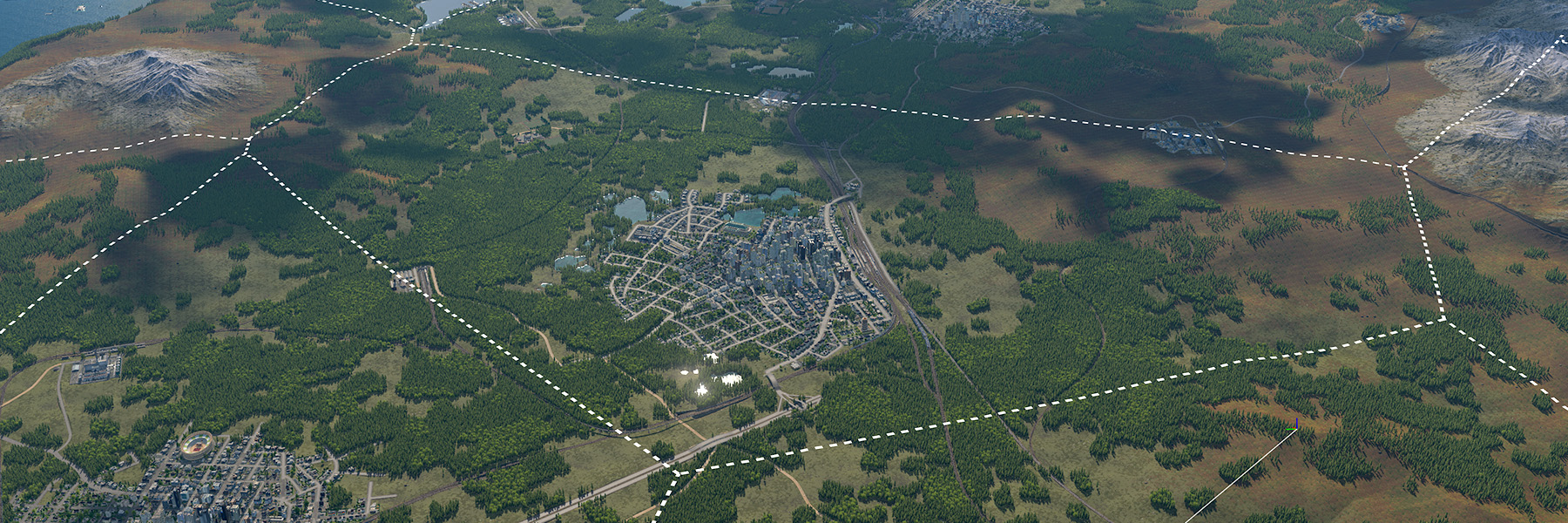
Die Spielwelt in Transport Fever 3 ist nun in verschiedene Gemeindegebiete aufgeteilt, die jeweils die Region um eine Stadt umfassen. Diese spielen eine grosse Rolle bei den strategischen Überlegungen des Spielers, da sie einen Einfluss auf verschiedene Spielmechaniken haben, sei es bei positiven Bonuseffekten oder negativen Auswirkungen, beispielsweise durch Verschmutzungen und Abholzung. Es muss deshalb immer gut abgewogen werden, wo etwas gebaut wird, um das Maximum heraus zu holen.
Ein gutes Beispiel ist die Platzierung des Firmensitzes am Anfang des Spieles. Da er nur die nächstgelegene Stadt mit einem Wachstumsbonus versieht und bei späteren Erweiterungen des Firmensitzes noch etliche weitere Boni dazukommen, muss der Spieler schon früh wichtige Entscheidungen treffen. Diese Firmensitz-Erweiterungen werden übrigens auch durch höhere Ränge im Unternehmen freigeschaltet. Es lohnt sich also, ein Auge auf die gesamte Entwicklung der Welt zu halten, und nicht nur auf eine einzelne Region.
Neben den Firmensitz-Erweiterungen gibt es eine Vielzahl einzigartiger Wahrzeichen. Sobald sie vollständig aufgebaut sind, haben sie jeweils einen spezifischen Effekt auf die Region, in der sie gebaut wurden. Entsprechend ist auch hier das Geschick des Spielers gefragt, um die optimale Position für den besten Einsatz des Bonuseffekts zu finden. Es winken aber auch Boni, mit denen der Spielverlauf beeinflusst werden kann. Einer davon ist die Prospektion neuer Rohstoffvorkommen in der Umgebung einer vom Spieler gewählten Stadt. Es gibt aber auch Marketingkampagnen für Städte, sowie weitere Mechaniken und Gebäude mit speziellen Eigenschaften. Aber Achtung, viele Massnahmen stehen nur in einer begrenzten Anzahl zur Verfügung oder haben Nebeneffekte. Dadurch ist der Spieler gezwungen, stets strategisch vorzugehen.
Vom Kleinen Weiler zur Grossen Metropole
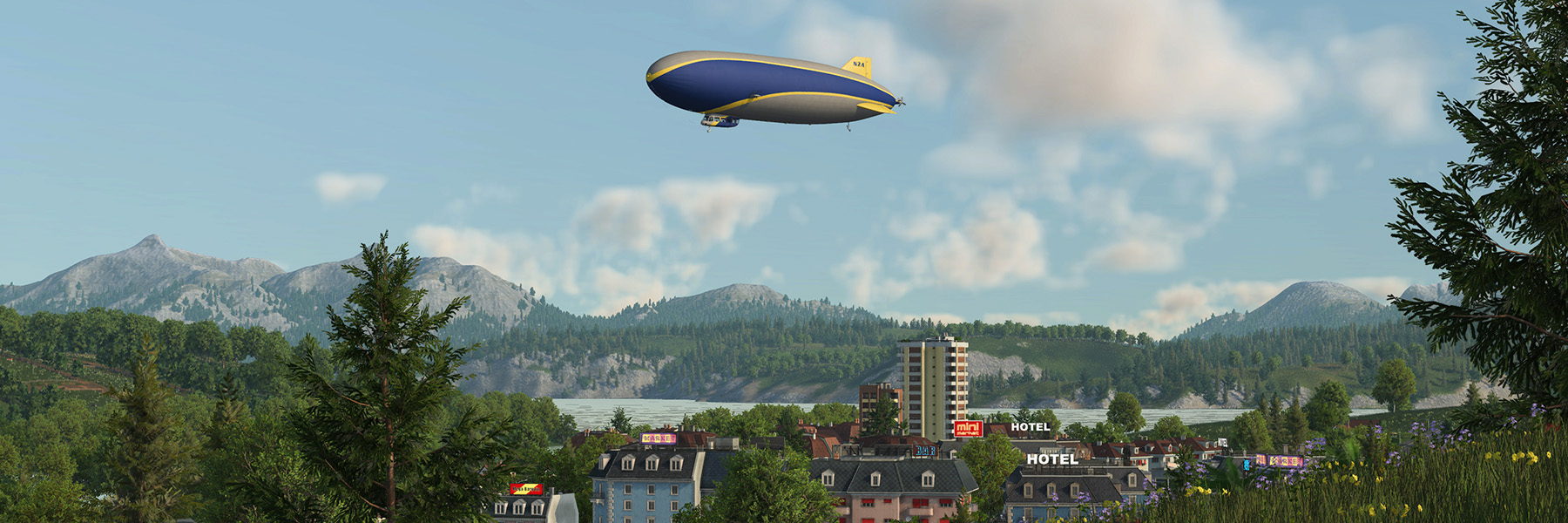
Die kleinsten Siedlungen mit teils weniger als 100 Einwohnern werden als kleine Weiler bezeichnet. Von dort sind es über Dörfer bis zu den Metropolen insgesamt 18 Wachstumsstufen, für die jetzt neu Erfahrungspunkte benötigt werden. Erfahrungspunkte gibt es sowohl für den Transport von Passagieren als auch bei der Versorgung mit den benötigten Gütern. Diese Mechanik koppelt das Wachstum der Stadt nun direkt an die Erfüllung ihrer Grundbedürfnisse. So verstehen Spieler viel schneller, was sie tun müssen, um das Wachstum anzukurbeln.
Für Passagiere, welche auf dem Weg vom Wohnort zum Arbeitsplatz bzw. zum Einkaufen lediglich in der gleichen Stadt unterwegs sind, gibt es weniger Erfahrungspunkte als für diejenigen, die von Nachbarstädten oder noch weiter weg anreisen. Dies bietet einen Anreiz für eine aufwändigere und teurere Infrastruktur.
Ganz ähnlich funktioniert es bei den Güterbedürfnissen. Städte benötigen abhängig von ihrer Grösse verschiedene Mengen unterschiedlicher Gütertypen. Je komplexer der Gütertyp, also wie viele Industrien in der Produktionskette liegen, desto mehr Erfahrungspunkte gibt es für die Stadt, in der sie abgeliefert werden. Daher ist auch hier zu entscheiden, ob der Fokus eher auf einfache Lieferketten gelegt werden soll, die viele Güter für wenige Erfahrungspunkte in die Stadt bringen, oder eher auf komplexe Lieferketten, welche weniger, aber dafür stark wachstumssteigernde Güter liefern.

Städte in Transport Fever 3 werden aber nicht einfach nur grösser, wenn man ihre Personen transportiert und die Güternachfrage deckt. Je grösser eine Stadt wächst, desto mehr Probleme werden auftauchen. Jede Stadt bewertet daher ihr eigenes Wohlbefinden anhand von 6 Bewertungen, welche alle direkt durch Aktionen des Spielers beeinflusst oder indirekt durch deren Infrastruktur verursacht werden:
- Ruf: Wenn für den Bau eines Flughafens ein ganzer Wald abgeholzt werden muss oder riesige Erdmassen bewegt werden, verärgert das die Anwohner. Ein schlechter Ruf erholt sich über längere Zeit. Es gibt aber auch Möglichkeiten, den Ruf aufzubessern, wie zum Beispiel das Pflanzen vieler Bäume.
- Zufriedenheit: Das Wohlbefinden der Fahrgäste hängt von ihrer Reiseerfahrung ab. Sie dürfen nicht zu lange an Stationen warten müssen und auch die Reisezeiten werden bewertet. Damit sie auch bei längeren Reisen nicht unglücklich werden, kann es sich lohnen, in schnellere oder komfortablere Fahrzeuge zu investieren.
- Lieferung: Alle Güter haben eine erwartete Lieferzeit. Während Lebensmittel eher zeitkritisch sind, haben Schüttgüter wie Steine eine deutlich höhere Toleranz. Entsprechend braucht es für diese vielleicht auch nicht die teuren, schnellen Flugzeuge und der langsame Seeweg ist die wirtschaftlichere Option. Zu spät gelieferte Güter bringen zwar immer noch Einnahmen, aber die Bewertung der Stadt sinkt.
- Verkehr: Grössere Städte haben mehr Einwohner. Diese wollen auch an ihre Ziele kommen. Wenn die Stadt irgendwann im Verkehr versinkt, sinkt auch dieser Wert. Dann ist es an der Zeit, die Infrastruktur zu verbessern oder in guten öffentlichen Verkehr zu investieren.
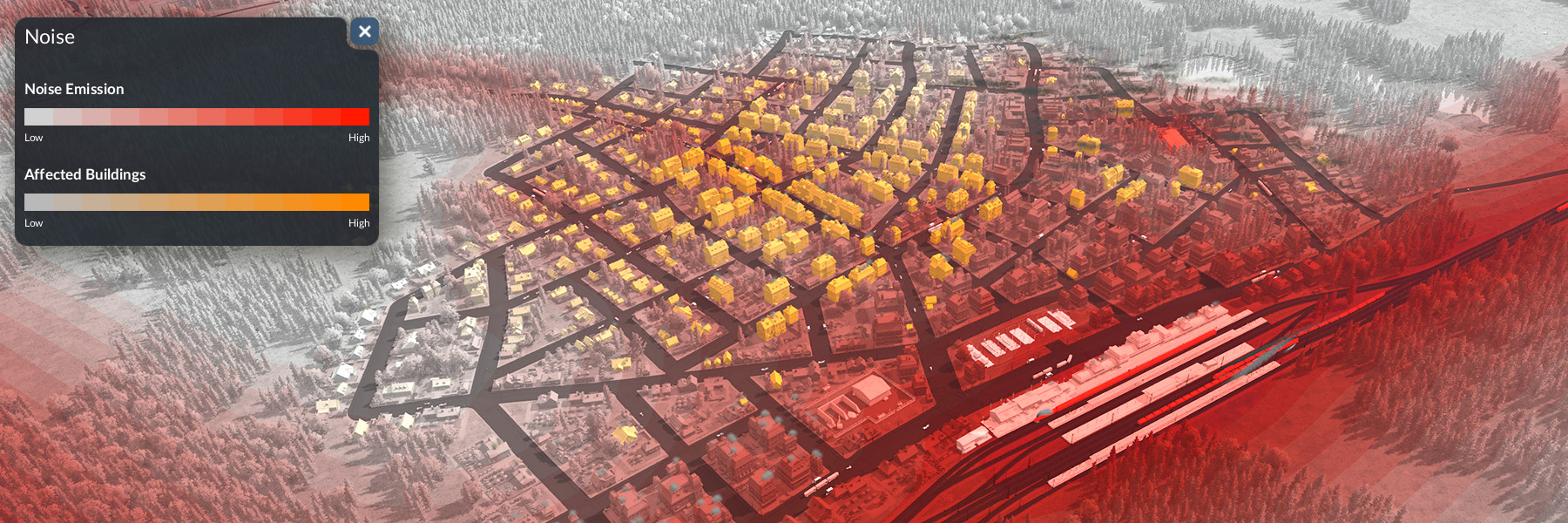
- Lärm: Die Bewohner der Wohngebiete mögen keinen Lärm. Das stellt den Spieler vor ein Dilemma. Kurze Wege zum lauten Bahnhof, oder lieber doch den grossen Verkehrsknoten am Stadtrand und die nahe Erschliessung mit leisen Bussen und Trams? Das erhöht aber wiederum die Reisezeit und kostet zusätzlichen Unterhalt.
- Verschmutzung: Industrien, Infrastruktur und Fahrzeuge verursachen Verschmutzung. Da diese im ganzen Gemeindegebiet erfasst wird, kann nicht einfach nur um die Stadt herum gebaut werden. Um zusätzliche Schmutzquellen zu vermeiden ist es wichtig, die Infrastruktur minimal aufzubauen und möglichst effizient zu nutzen.
Die Stadtbewertung ist also ein Zusammenspiel aus der Qualität der Transportlinien, der Verkehrssituation und von Umweltaspekten und skaliert die Anzahl der verdienten Erfahrungspunkte.
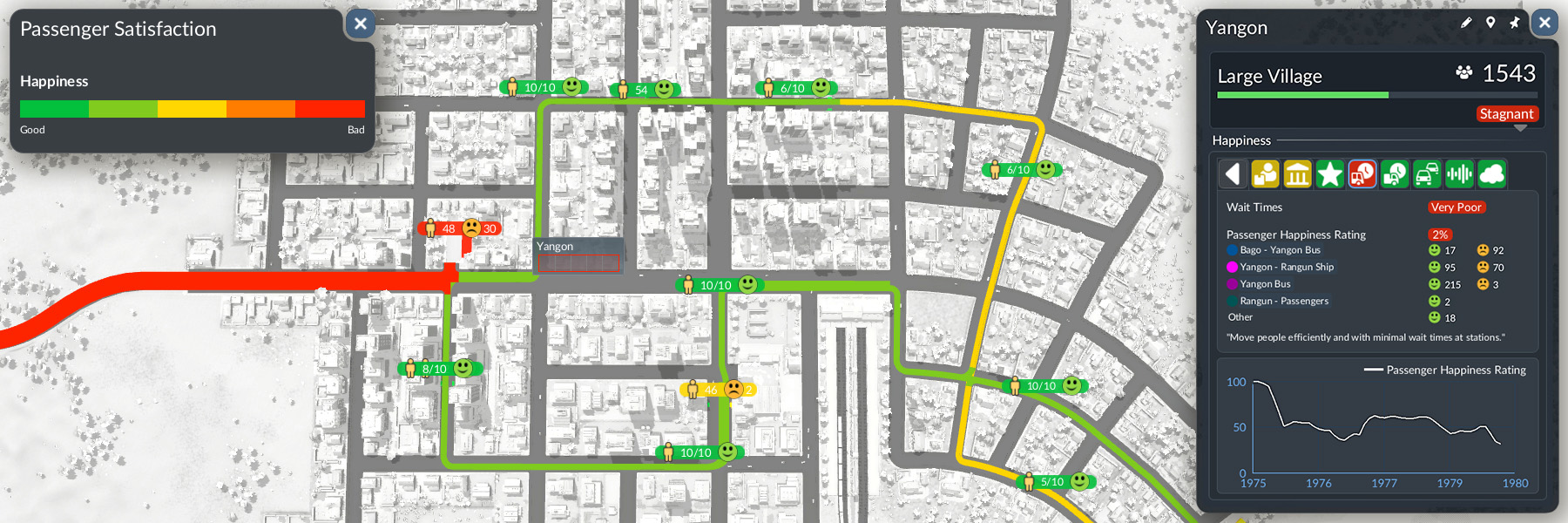
Dabei beschränkt das Minimum dieser Werte den Wachstumsfaktor, also wie ergiebig die gesammelten Erfahrungspunkte für die Stadt wirklich sind. Es ist deshalb nicht ratsam, das eigene Netzwerk ohne Rücksicht auf die Städte aufzubauen oder einen der Aspekte auf Kosten der anderen zu perfektionieren. Vielmehr muss der Spieler die Abdeckung der Grundbedürfnisse und die Infrastruktur in und um die Städte miteinander balancieren, um alle Bewertungen zu maximieren, und so eine möglichst hohe Wachstumstrate zu erwirken.
Städtewachstum, neue Fahrzeugtypen und Veränderungen in den dynamischen Industrien sorgen zudem dafür, dass sich die Rahmenbedingungen immer wieder ändern. Im Verlauf des Spiels stellen sich so kontinuierlich neue Herausforderungen und es gilt aus den vielen Optionen diejenige zu wählen, die gerade am besten passt. Denn jede Entscheidung hat auch ihre Nebenwirkungen.
Vom Tycoon-Spiel zur Sandbox
In Transport Fever 3 werden der eigenen Kreativität keine Grenzen gesetzt. Darum gibt es beim neuesten Teil der Serie auch wieder eine Vielzahl an Möglichkeiten, das Spielerlebnis frei zu gestalten.
Alle Kosten im Spiel können einfach ausgeschaltet werden. Damit kann der Spieler alles bauen, ohne sich um Finanzen und begrenzte Budgets sorgen zu müssen. Wem das nicht ausreicht, der kann sich auch gleich von Anfang an zum Tycoon befördern lassen und erhält alle Boni und Wahrzeichen direkt von Beginn an.
Am mächtigsten ist der Sandbox-Modus, mit dem sich etliche zusätzliche Werkzeuge freischalten lassen, um die Welt nach Belieben zu gestalten und zu steuern. Sie ermöglicht unter anderem, in der Zeit vor und zurück zu reisen und erlaubt es, neue Städte zu gründen und alle Industrien frei zu platzieren.
Darüber hinaus wird Städtebauern im Sandbox-Modus in Transport Fever 3 einiges geboten: Wer gerne mehr Kontrolle über die Städte hat, kann unter anderem die zu liefernden Frachtarten konfigurieren und die Stadtgrösse nachträglich verändern. Wen das Stadtwachstum stört, kann Städte auch komplett einfrieren. Wer ihnen einen individuellen Charakter verleihen möchte, kann die prozentuale Verteilung der Gebäudelevel anpassen. Von reinen Vorortsiedlungen bis zu ausgeprägten Skylines ist alles möglich. Wer nicht so weit gehen will, aber trotzdem mehr Kontrolle über einzelne Städte haben möchte, kann auch einfach die oben beschriebenen Bedürfnisse der Städte neu gewichten.
Vom System zur eigenen Geschichte
Die in dieser Episode vorgestellten Tycoon-Mechaniken können selbstverständlich auch Grundlage für Mods sein. So ist es z.B. möglich, in Fracht-Modifikationen festzulegen, welche Frachtarten ab welchem Level von den verschiedenen Stadtvierteln benötigt werden können und zusätzliche Wahrzeichen lassen sich einfach ergänzen. Da bietet Transport Fever 3 der Modding-Community ganz viele neue Möglichkeiten.
Zwischen expandierenden Städten und steigenden Unternehmensrängen zeigt sich: Jede Strecke, die gebaut wird, schreibt ihre eigene kleine Erfolgsgeschichte. Deshalb sind wir gespannt, welche Geschichten ihr in Transport Fever 3 erzählen werdet.
Matthias Gürtler
Lead Product Engineer

68 Antworten
Finally the stuff once promised to Cities: Skylines II players are confirmed here.
Since buying its predecessor TPF2 on its day of release along with the deluxe add on I have been an avid fan, currently have 3,300 plus hours and thanks to the avid modders am running with 1100 plus mods. My only wish for the latest version is that it has been optimised better for those that cannot afford the very high end rigs, i chose my rig especially for the game taking into account the game is heavily reliant on single thread performance and chose a relatively good cpu, being a pensioner my resources were limited on the gpu so only have a RTX 3080 preferring the constant regular updates Nvidia provides over its competitors. Saying that I am hesitant to play maps bigger than the large ones making sure there are not dense amounts of forest over the map and therefore I can maintain a good 90 to 110 fpm. Congratulations on an amazing game and am eagerly awaiting the release of TPF3.
We hear you! We’re purposefully testing the game on a wide range of hardware set-ups to help with the optimisation process. Depending on the hardware that you have, you may need to play on smaller maps, or with fewer towns on the map, but we’re hopeful that as many people as possible will be able to enjoy the game with strong performance. Once we announce the final recommended specs for the game, you’ll be able to judge how well your PC will run it.
Hi Sam, any chance you re-coded some of the codebase so that all npc calcs are spread across multiple cores?
I would really appreciate clarity, before the release, what performance I can expect from TPF3 in the end game. This is most critical for me and the reason why I stopped playing TPF2 long time ago. I loved the game but with that single-core limitation, the game was out of time for modern PCs and became a big frustration for me. Biggest problem was not even the pretty low FPS due to the CPU bottleneck in the end game, but the stutter every few seconds that froze the game shortly and made it impossible to enjoy it any more (at least not in first-person mode). Unfortunately, you already confirmed that TPF3 doesn’t change that bottleneck and that worries me very much.
I will not buy TPF3 if I run the risk of exactly the same issue during the end-game. I love the first-person rides in public transport vehicles (trains, buses) and if that stutters during the end game, I’m off that game. And, I need very large maps to enjoy the rides, so please don’t tell me that I can only use small or medium size maps, because then I won’t buy the game either. If necessary, however, I’d be willing to reduce the number of cities / population growth if that helps (and it usually is the biggest drivers for the CPU bottleneck).
Given this situation, I propose that the game should provide a kind of “end game performance preservation” slider where, if set in / at the beginning of a new game, it changes the growth curve and number of cities (and maybe number of trees or similar) so that the simulation still runs well during the end-game, keeping population reasonable. It should not, however, limit the visual quality, which I can set separately by graphics options and which usually also does not drive the CPU bottleneck too much. And you should provide recommendations how to set that “performance preservation” slider for certains PC rigs for certain expectations (max. population growth vs. protecting certain performance levels). So I recommend you provide clarity about what can be expected with a certain PC setup and a certain game config (map size, # cities, i.e. setting of that slider if implemented) to avoid total frustration again. I have a PC with an AMD 9800X3D, RTX 5080, 64GB RAM and a very fast SSD, so it definitely cannot be my PC rig that’s the limit for the game. Please consider my input accordingly.
What system are you running on? I have a much weaker system and no problems. I had heavy performance issues in windows 11, switching to Linux mint was a game changer
I have not played TPF2 on the mentioned system but on an older system (that was rated “high-end” back in the days as well, on Windows 10). I am also aware that it depends on how you play the game. As long as you mainly play in birds-eye mode, these performance issues are not too visible for most. But as soon as you enter the first-person camera in the cockpit of a train, tram or bus, it becomes a massive issue. The first person mode is, however, for me a key element of the game that I enjoy most. I always have a dedicated, optimized gaming PC with no other applications running in parallel (and I am an IT professional for 30 years … does not mean I know everything but I certainly have some experience 😉 ).
en sevdiğim oyun düşük bütçeli insanlarıda düşünürseniz seviniriz. birde çok dilli olursa daha da iyi olur.
Can’t wait for this!
A train station doesnt make any sound which goes as far as the layout shows…..
The only thing hearable at a train station are trains and road vehicles, not railway.
Girls, really? What are you doing?
I agree with you it looks far too much and not realistic.
I believe that it is indeed the trains causing the noise pollution, and that this overlay just shows the average pollution in that area over time as trains pass by.
Yes that is how the emissions overlay works in TPF2. You can toggle it between current immediate emissions and average emissions, which I assume is what the screenshot is showing. Given that, despite the high quality of them, these are still pre-release materials and it will likely clarify this in the final release.
Prospecting sounds interesting, being able to get new raw material industries on the map is useful and opens up more strategies for scaling production (in addition to the already mentioned production upgrades and cargo/workers boosters). However, will we be able to fund new manufacturing industries in tycoon mode as well? At some point, additional raw materials won’t be useful unless we can get additional manufacturing throughput!
While I’m confident UG is able to deliver a great game (based on the previous ones), I’m afraid that many competing systems like these will be just like emissions in TpF2. You just ignore them because there is not much to do. While in TpF3 I can build noise barriers and plant trees, I also need to increase/improve service in the town, which means more noise and more pollution. And as the blog said, it won’t help much to build a station outside the town. So I’m afraid that, in the end, the player will just ignore all of this and play the best they can, because it’s literally impossible to rank highly on all those ratings. Or maybe we can choose a region to be the industrial area and another to be the residential area? That would be nice, but then again, there wouldn’t be many cities, but one city with large districts far from each other. Also, is it even possible to develop a city that is mainly industrial? It will have pollution. No residences to complain about noise, but pollution, yes.
I hope the game will still be enjoyable even with these systems on, because I wouldn’t want to turn everything off, but I also wouldn’t want to never be able to deliver top-notch service.
About the headquarters, will its style change with the eras?”
This game may not funny than TF2. Too many unnecessary elements were added.
8 missions sound quite small, I hope there will be more content and maybe country and history based challenges for players who like to play scenarios
希望铁路细节能够有所改变,比如可动道心道岔
Ja, das wäre schön. Und dazu noch ein “Stellwerk” mit Tableau für die Steuerung und Ansicht der Zustände der aktuellen Verkehrsströme auf den Gleisen. Ich höre schon das Klackern der Gleisweichen. 🙂 Denkbar wäre in diesem Zusammenhang auch ein Rangierbahnhof zum Zusammenstellen der neuen Züge, in Verbindung mit einer Drehscheibe. Nicht nur “Trennen”, der eine Zug fährt mit paar Wagons links, der Rest rechts raus. In meiner Jugend gab es in Deutschland auch noch den “Schienenbus”. Da konnte der Schaffner vom einen Ende zum anderen Ende umsteigen (durchgehen) und quasi rückwärts (vorne=altes Hinten) mit dem “Bus” zurück fahren. Das hatte die Drehscheibe erspart. Ich denke in den Regio-Zügen geht das auch, aber habe keine Ahnung, wie es heute gelöst ist. # Für den Augenblick denke ich, haben “unsere” Entwickler alle Hände voll zu tun, sonst hätten sie das Ostergeschäft nicht sausen lassen. Die Qualität des Spieles ist ihnen wichtiger, als der schnelle Franken (CHF) – das freut mich. Und, bei all unseren Wünschen: Es braucht auch noch Ideen für die ersten updates.
It would be really cool if train sets could be split. That means that a train pair with, for example, 2 train sets enters the station, then decouples in the middle, and then either goes in different directions or the rear train set waits briefly and first travels in the same direction, but later goes in another direction.
Oh that is a feature request I support. A dividing trains (Flügelzüge) would be sooooooo cool.
I second this support
Yes agree, or you can have a a line and some trains only use the most busy part and turn around. Now sometimes use four lines in the same track.
Hello, given the day/night cycle, are you planning to introduce timetables/rush hours etc.?
I’m a fan of this franchise since Transport fever 1 and I can’t wait to play this!
Overall, really good changes to transparency compared to TF2. Seeing what exactly grows the town based on EXP might sound gamey, but will overall drive the need to optimize. I like that we do not have to fight to keep an EXP level, and that other aspects also impact the town level, like pollution, reliability, and reputation.
I want to address one more thing that is really near and dear to me—what really won me over in TF2, which now ranks as my second-favorite management game after IG2. And that is the absolutely bonkers and highly entertaining campaign story missions through the ages. I really like how game mechanics and even terrain tools were used for side quests and main quests. I overall enjoyed how much we saw from different angles of history with a very well-measured dose of humor.
I can’t mention enough how much fun I had with the campaign—from Switzerland in the 1940s to the Great Leap Forward in China and the crazed millionaire in Los Angeles. The Florida mission, and especially the mission in the USSR with the dictator and his marble palace, really stuck with me.
So please, please, please keep those crazy scenarios. Let me slip into the shoes of a transport tycoon doing his job no matter the time and place. It’s amazing!
Will the restriction requiring trucks to carry only one type of cargo be lifted? It is simply unrealistic to expect that a truck should not be able to transport both goods and construction materials.
tf series are great and each new game is inevitable to grow with more options and stuff, advancements, that when in capable hands can bring excellent game play.
“Über 400 neue Stadtgebäude spiegeln das dynamische Stadtwachstum wieder”, steht unter einer Bildunterschrift zu lesen. Kleiner Tippfehler!
Danke für die Anmerkung und gutes Auge! Wir haben den Fehler soeben korrigiert.
Non vedo davvero l’ora!!!!!!
I want to see more mega project missions with different resources required for the project like the English channel tunnel at the end of the European campaign. I have noticed that open ttd town system is here now and I want to know if it will be as annoying at open ttds where it prevents you from building a bus stop on the side of the road.
Will there be a video for this one aswell?
This article pairs with the First Look video we posted most recently.
Video is out since weeks as the video comes always before the dev blog
It would be nice if they’d at least announce the release date for my favorite game. I keep checking back and grinding my teeth. We’re already past the first quarter of the year, and the date—2026—is becoming unbearable while I’m waiting for my favorite title. Since I’m going to spend thousands of hours playing it later this year, I’d like to mentally prepare myself for it :))))))
Hello, it is pointless to always ask about the release date. It will be announced when the time comes. Please dear Urban Games team, do not let such comments unsettle you. Your path is exactly right. Please only announce it when you are 1000% sure it is finished. My biggest disappointment was Cities: Skylines 2. They released an unfinished game.
Deutsch:
Hallo , es bringt nichts immer nach dem Veröffentlichkeits Datum zu fragen. Es wird angekündigt . Wenn es soweit ist . Bitte liebes Urban Games Teams , lasst euch von sölchen Kommentare nicht aus der Ruhe bringen . Euer Weg ist genau richtig . Kündigt bitte erst dann an wenn ihr 1000% sicher seid das es fertig ist. Meine größte enttäuschung war Cities Skylines 2 . Die ein unfertiges spiel raus gebracht haben.
Like!
I wish in TPF3 theres were trolleybuses,basically tram and bus mix and perfect for neighbourhoods which cannot fit trams
Trolleybuses can fit also batteries to run as an electric bus
In TPF2, lots of us put cities very close together to create megacities, but you’d have to either deal with industries ruining everything while sitting in the middle, or prune out all industry at the cost of growth.
If I’ve understood it correctly, with this new town levelling system… I can prune out all industries from downtown, and as long as my commercial and residential problems are good, and I have good transport to some sort of industrial megacity elsewhere, it should be easier than ever to make those megacities, right? If so, I’m very happy!
When a passenger changes vehicles, he will not take the first line available but the line he “booked” when leaving home. So buses and trams might run by empty, because they belong to a different line, even if they serve the same destination. This is an annoying limit in TF2. Is it going to be smarter in TF3?
Improving the decision-making, and the appearance of smarter choices is an area we have already dedicated time to. The challenge however is in making sure that this doesn’t lead to excessive extra processing on the part of passengers, since this is where it’s possible that game slowdowns can occur. The goal is to improve the way that decisions are made.
Wird es Möglichkeiten geben, in allen Spielmodis wie Karriere oder Sandbox Tätigkeiten mehrfach hintereinander rückgängig zu machen? Das hatte mir in TPF2 leider gefehlt, sofern ich das nicht übersehen habe, so viel habe ich es nicht gespielt.
Auch die Leitung, auf welches Gleis ein Zug soll, um zum Beispiel mal umzuleiten. Einbahnsignale waren zu umständlich und unrealistisch, da es bei der Eisenbahn zumindest in Deutschland sowas nicht gibt. Daher hoffe ich auch ausreichend diverse Signale.
In the very first trailer, I remember seeing pedestrian bridges. And so far, we haven’t seen any mention of them, or of pedestrian paths. Are they going to make their way into the game?
Perhaps you can brand SandBox mode as ” The Creative mode” . First, it sounds better, and second it better describes what is the purpose = pure creativity mode.
Can we make trains like cars, allowing them to take two routes simultaneously, and let them detect which route can be passed through at the fastest speed and choose that one? This will improve the operational efficiency of three-line railways
Dear Urban Games Team,
Greetings to all of you!
I’m really looking forward to the release of Transport Fever 3, and I know I’m not alone. But while we patiently (or not so patiently) wait for the next chapter, I have a humble request regarding Transport Fever 2.
Would it be possible to add smooth road-to-highway transitions — the kind we saw in the TF3 announcement teasers — into TF2 via a patch or update?
I’m asking because such a small but meaningful addition would give us a lot of joy and help keep our minds busy while counting down the days until TF3 arrives 😊
Thank you very much for your hard work and for listening to the community.
Best regards,
A dedicated Transport Fever fan
We have to keep our attention focused forwards, otherwise we’ll never reach the final release of the game! Transport Fever 2 is alive and well, but we are no longer actively developing it as all our attention on the next evolution of the series, and we strongly believe it’ll be worth the wait.
Zumal die Strassenverkehrslogik jetzt deutlich überarbeitet wurde, scheint es, dass hier neue features möglich sind.
# Ist die Lärmbelästigung abhängig vom Gewicht der Fahrzeuge (Individualverkehr/Lieferverkehr)?
# Können künftig Verkehrsströme zum Zwecke der Reduzierung der Lärmbelästigung aktiv mit “Wegpunkten”, mit “Einbahnstrassen”, mit “Zulässigem Höchstgewicht”, mit “Zulässiger Höchstgeschwindigkeit” bei sensiblen Stadtgebieten gesteuert werden? Oder nur passiv mit “Lärmschutzwänden”? (Ich könnte mir auch optional, eine temporäre Behinderung durch zufällige oder geplante Baustellen auf Fernverkehrsstrassen mit Organisation von Umleitungen, aber auch innerorts vorstellen.)
# Soll es eine “Ampelsteuerung” mit “Grüner Welle” für priorisierte Hauptadern/-verkehrsadern in den Städten geben?
# Können die “Speditionsplätze” Anlieferung/Abholung bei produzierendem Gewerbe jetzt auch so gesteuert werden, dass die Zufahrt und Ausfahrt der jeweiligen Linie zum Lagerplatz genau bestimmt werden kann? (Das ist in TF2 ein Chaos, Ladeplatz alleine reicht nicht.)
# Gibt es “Speditionslager” mit Umladung/Zwischenlagerung/Neukonfiguration der Ladung zum Zwecke der spezifischen Anlieferung an bestimmte “Produzierende Unternehmen” entsprechend der Bedarfsverhältnisse zur Produktion (1xA + 2xB + 3xC = 1x Produkt D) und zutreffender Auslieferung an bestimmte Empfänger gegen Entgelt/Mehrkosten beim Transport oder bleibt dies generell den Moddern überlassen?
Gerne erfahren wir von Ihrer Planung.
Any chance of getting any Czechoslovakia mission? Like building metro lines in the 70s while improving tram and bus lines? 😉 And all that while commies are destroying old neighbourhoods and making large Panel housing estates?
We were pretty industrial, and you would have a lot to choose from and even reuse old soviet trains or use Czech vehicles in other Eastern European countries’ missions (and Germany). Also you could easily add industrial goals in this mission like building Švihov Reservoir. And spring of 68 aftermath would be interesting historically and you could easily connect it with noise and pollution mechanics.
Just saying 😀
Transport Fever 3 includes a collection of campaign missions that span the globe and give you plenty of diverse challenges to test yourself against. Naturally, every player would like to see their home country included in the selection we’ve made but it simply isn’t possible to satisfy everyone. We’re sure you’ll have a good time with the settings we’ve chosen though, even if your country isn’t one of those included.
Dear Urban Games Team,
Greetings to all of you!
I’m very excited about the upcoming release of Transport Fever 3, and while you’re hard at work on it, I’d like to take the opportunity to share a couple of ideas that came to me while playing Transport Fever 2.
Now, here are my suggestions:
1. Option to block automatic building spawning alongside city roads
When building a new road inside a city, it would be wonderful to have a toggle or a tool that prevents buildings from automatically popping up along certain segments. Sometimes you just want to leave a green area — a park, an empty space, or just a visual break — but the game inevitably fills every roadside with buildings. A simple “no buildings here” option would be a game-changer for city aesthetics.
2. Zoning control for commercial, industrial, and residential areas
This is something that came to my mind immediately: the ability to assign specific zone types to city road segments.
For example, you build a new road and want to supply commercial goods there, but instead, residential or industrial buildings appear. It would be amazing to choose in advance what type of buildings can grow along a given road — commercial, industrial, or residential.
This would allow us to create proper industrial districts, separate residential neighborhoods, and commercial zones. It would also make local trains and trams much more relevant, because people would need to travel between these specialized districts. In TF2, to be honest, I mostly solved everything with buses — I only used trams a couple of times (sorry!). Not because they’re bad, but because the game didn’t really give me a strong reason to choose them over buses. Proper zoning could change that completely.
Thank you so much for all your hard work. I can’t wait to see what you do with TF3!
Best regards,
A devoted Transport Fever fan
To pick up on one of your points, trams may seem like “bigger buses” when you first implement them, but the positive impact they can have on inner city transport is massive. That’s before you then consider the possibilities that arise with the new cargo trams. We encourage you to give them a try, you may be pleasantly surprised.
100% on n.1 Being able to stop the game from building crap everywhere was a big problem on TF2…
I wish the TPF3 team considers adding various country’s maps as default map so that we players can play their countrys map in the game eventually replicating the existing rail routes and highways in the game for more fun and interesting !!!
The in-game Mod Browser will almost certainly give you the variety of map locations you desire. If Transport Fever 2 taught us anything about the community it is that they are very adept at creating and sharing some truly fantastic maps, many of which will be based on the real world.
give us a proper release date already dear sirs/madams…
Rest assured that as soon as we are ready, we’ll announce the release date very widely. The wait won’t be too much longer.
One thing that would be fantastic would be the addition of villages. This could be simply extremely small towns that hardly grow, with inhabitants that are more likely to be drawn to the nearest big city, and some random other cities. In the series I have always been missing the incentive to differentiate between local and intercity trains, and this would add so much depth while it could be a relatively simple feature. One gameplay problem would be a low incentive for the player to even care about these villages, but perhaps this could be compensated for by some parameter, maybe something about passenger satisfaction or subsidies.
I know this is a very late suggestion, but who knows 🙂
Thank you
Every town starts out at village size, so you can replicate the effect you’re after by not developing those smaller settlements. If you lock the settlement size in place, you’ll be able to keep them as smaller elements of your overall game world.
Nice, being able to lock development per settlement is also a good solution!
I hope the revenue formula is changed from distance-based to something else. In TF1 (which I liked way more than TF2 by the way) it was optimal (economically) to build fast and long lines to the farthest destinations possible (even when there were other sources nearby customers paid a lot more based on distance and speed if I recall it correctly). I hope a more realistic (or fun) model will be implemented this time.
We have paid close attention to feedback received based on Transport Fever 2’s financial system, and revised the way payments are calculated to make the distant cargo route method a thing of the past. Long distance passenger travel at speed will continue to pay well, but when transporting goods, it is the complexity of the cargo being delivered that is far more meaningful when it comes to the payment received. It won’t always be possible to find a supplier right next to each town which will place a greater emphasis on building effective distribution.
Looking forward to it. The more this game follows transport tycoon the better and it certainly looks to be more aligned. As I’ve said before, the lack of UK asset pack was frustrating for me on console as the availability of mods was so poor.
Not sure if it has been asked before, but are we finally going to have real working turntable or transfer bridge for the railway system? It would be a nice feature..
Can’t wait.. so excited!
Just hope I can buy the Mac mini M4 version via GOG Games!
Can we put our own artwork and Logo’s on vehicles?
Through modding this is entirely possible. The personal logos option that existed with the original Transport Fever (but not with Transport Fever 2) is not included in the game.